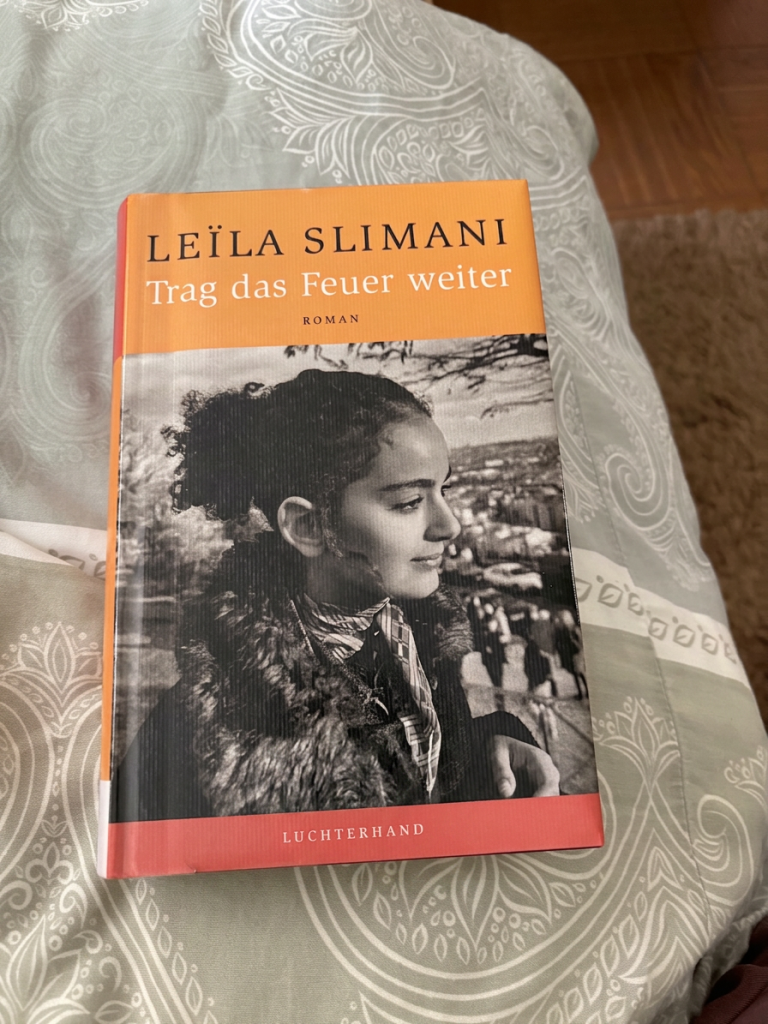
With Le Pays des autres 3: J’emporterai le feu (Éditions Gallimard, Paris 2025) Leïla Slimani has brought her wonderful family trilogy to an end; as too comes my reading of it in German translation as Trag das Feuer weiter (Übersetz. Amelia Thoma. Luchterhand, München 2026). (Published last month in the US by Penguin as I’ll take the Fire; a title with which I could quibble as I understand in the original and the German title the emphasis to be on continuity – over generations, those passed and those to come – that is missing here. I would say ‘carry’ rather than ‘take’, and ‘torch’ seems to me to be more descriptive of the passing on (in classical mode I’m thinking about a relay, the Olympic flame), but whatever … And translated again by Sam Taylor.)
Over some years now, I have been captivated by Slimani’s saga that draws upon her own family story; the first part exploring the grandparent generation so to speak, the second, that of the parents and this third, the author’s own, bringing them altogether in a conclusion that imagines the non-conclusive, that is, the ‘what comes next’ being dependent on the ‘what came before’ – for better and worse – and every generation’s responsibility to keep the narrative alive even when the protagonists have moved on. By which, I do not mean that they are no longer (necessarily) amongst the living, but are getting on with living their own life, creating their own legacy, writing their own independent story.
A recent article in The Guardian alerted me to a Leïla Slimani residency at the Prado (Writing the Prado it is called), and it is in this capacity that the following video of a conversation between Slimani and Valerie Miles comes.
… I must say I think anyone who has just watched that will have a renewed commitment to participating in great art and literature, even if that only be by virtue of thoughtful appreciation as a viewer and reader. Over geographies and histories and cultures, it is the malleable nature of art that enables the bridging of differences that often appear insurmountable, offering a currency of exchange (the monetary metaphor is intended!) that is invaluable in a fractured world. Of course the more Leïla Slimani’s there are to communicate that message the better!