During the UK leg of her book tour at the end of last year, Emily Wilson accepted the London Review of Books invitation to present her Iliad translation. And they found a wonderful discussion partner for her in Edith Hall. And complimented by a thespian pair conjured from amongst the embarrassment of riches which is the theatrical talent of a nation – Juliet Stevenson and Tobias Menzies. Stellar, I say! Such an evening could only happen in London.
Tag: Emily Wilson
Thalia Potamianos Annual Lecture Series
And, should you ask: And what is that? I do quote:
Established in June 2020, the Thalia Potamianos Annual Lectures Series seeks to create a stimulating environment to draw the academic community and the public to the Gennadius Library of the American School of Classical Studies at Athens. Every year, a highly distinguished, internationally renowned scholar is selected to conduct research and develop programs on a topic relevant to the Gennadius Library. The research will culminate in a minimum of three annual public lectures, which will be delivered in Athens and the United States.
This program is being made possible by a generous grant from Gennadius Library Overseer Phokion Potamianos. Mr. Potamianos named the series in memory of his grandmother, a distinguished Greek biochemist, scientist, and philanthropist.
American School of Classical Studies at Athens
And, of particular interest to me, is that the current presenter is Dr. Emily Wilson. As per the schedule below, the first lecture was held in October in Athens, and the next two are in the US next year. (Of course, very timely considering Emily Wilson’s new Iliad translation!)
LECTURE SCHEDULE

2023–2024 Schedule for The Myth, Magic, and Mystery of the Ancient Greeks

Lecture I: The Vulnerability of Heroism

Tuesday, October 3, 2023 – ATHENS, GREECE
7:00 p.m. EEST (Greece) / 12:00 p.m. EDT (US)
Cotsen Hall, Anapiron Polemou 9

Lecture II: Destiny, Tradition, Choice

Wednesday, January 24, 2024 – GEORGETOWN UNIVERSITY (Washington, DC)
6:00 p.m. EST (US)
Gaston Hall, located inside the Healy Hall Building, 37th & O Streets, NW

Lecture III: The Wisdom of Stories

Wednesday, May 8, 2024 – NEW YORK CITY
6:00 p.m. EDT (US)
St. Bartholomew’s Church, 352 Park Avenue (between 50th & 51st Streets)
I embed here a video of the first lecture; and I will so do again with the remaining of the series – and in a more timely fashion.
Update: January 27 – Well, the first lecture has disappeared so herewith the second – though it may also have a limited life!
Update: February 2 2024 – Ditto the above! Time zone disparity didn’t allow for a live watching of the second lecture, and so I belatedly began to look at it a couple of days ago, only to get distracted and now the second lecture is also gone!
Update: May 21 – Gladly managed to watch the final lecture delivered in NYC last week (just in time!). From what I saw at least, these lectures were for a much more learned audience, but even a lay person/aged fan-girl such as I could garner rewards – and especially in this last one which focused on narrative and story-building. The juxtaposition of Pandora (from Hesiod) and Helen (from Homer); the former presented as a passive participant in her own story and the latter speaking in her own voice.
I don’t know why these recordings had such a ‘limited release’; should they return I will embed them again – but I fear not. Schade! I do wonder whether Dr. Wilson is not looking towards publication. I have noticed of late that very many lecture series are ending up in book form. That’s okay … I guess!
A hero on my doorstep
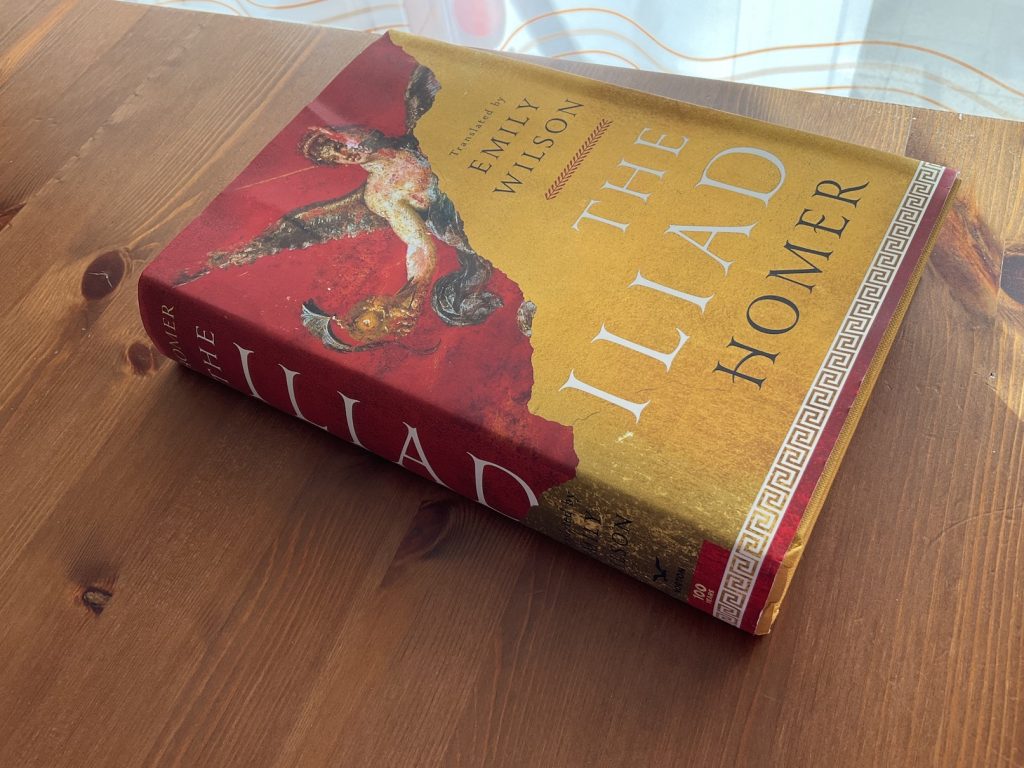
The god’s have favored me, and Emily Wilson’s new translation of Homer’s The Iliad has arrived promptly from across the wide Atlantic seas. And glorious it is indeed!
Homer, The Iliad, translated by Emily Wilson, First Edition, New York: W.W. Norton, 2023.
Below is the video of a recent event at the Library of Philadelphia promoting this newest work of scholarship. Emily Wilson is in conversation here with Sheila Murnaghan, chair of the Department of Classical Studies at Penn (and, therefore, a colleague).
The Iliad by Homer, translated by Emily Wilson review – a bravura feat | Homer | The Guardian
Six years on from her translation of the Odyssey, Wilson revels in the clarity and emotional clout of Homer’s battlefield epic
— Read on www.theguardian.com/books/2023/sep/27/the-iliad-by-homer-translated-by-emily-wilson-review-a-bravura-feat
There are sure to be many in the next days, weeks, so as I come across new reviews I’ll directly post them (if possible) – and comment later if I think necessary . This from Edith Hall, who hardly needs an introduction – but here’s one anyway.
What to read this autumn: 2023’s biggest new books | Books | The Guardian
Sara Pascoe’s new novel, rare Terry Pratchett, memoirs from Barbra Streisand and Britney Spears, plus the essential reading on today’s hot button topics – all the releases to look out for
— Read on www.theguardian.com/books/2023/aug/26/what-to-read-this-autumn-2023s-biggest-new-books
Autumn is it absolutely not in the south of Germany! The warmest of sunshine, leaves barely tinged and little change in sight. But nevertheless it is a good time to start planning for days indoor. For this “The Guardian” has some good suggestions. Not necessarily those mentioned above in their pulled quote, though by Streisand I could be tempted. Of the others, some expected and therefore of no surprise: Zadie Smith, Mary Beard, Emily Wilson. And one who I will be particularly thrilled to read again after all her travails in the last few years: Jesmyn Ward – for this I have been waiting.
According to Emily Wilson
It is 26 September 2023 and Emily Wilson’s translation of Homer’s The Iliad is published today.
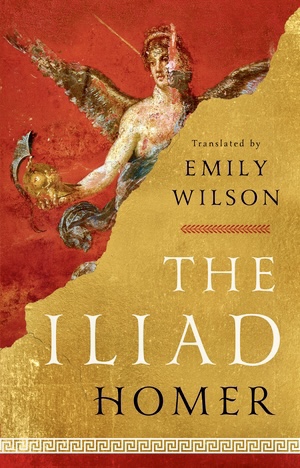
To whet the appetite, some of the first reviews:
- Natalie Haynes in the NYTimes
- Daniel Walden: The Bulwark
- Naoíse Mac Sweeney: The Washington Post
- A.E. Stallings: The Spectator
- Emily Greenwood: The Yale Review
No, they have not been thoroughly read, but I can say the headers and quick scans of each suggest – more than suggest – high praise, and sung in unison. Which would delight the Muses no end. Emily Wilson, herself, seemed particularly taken with The Bulwark (not known to me – looks really interesting, but mostly sub. based) piece.
Beyond the book, gossipy even (and adventurous: wouldn’t you like an assignment that takes you to Ithaca? And not that one in the Empire State), is Judith Thurman’s piece for The New Yorker “How Emily Wilson Made Homer Modern”. An entertaining read, though the “modern” of the title, if one is to understand correctly Wilson’s comments in the above thread where she makes a point of voicing her displeasure at a simple reception with the claim of “modernizing Homer”, is probably misplaced. Also, Charlotte Higgins’ piece in The Guardian a couple of weeks ago writes of the the technical choices Wilson contended with in her translation of the Iliad that culminated in today’s publication.
And at Lit Hub, Emily Wilson in conversation with her friend, Madeline Miller, reveals further insights into her methodology as a translator, the psychological depth of Homer’s poetry and into her character interpretations – also a great read:
And, finally, a diary entry unto myself: BBC Radio 4 Start the Week on Monday, 2 October – “The Iliad and the right to rule”. Adam Rutherford and his guests EMILY WILSON, Mary Beard and Ben Riley-Smith “explore the battle for power and the right to rule”.
I look forward so much to reading, reflecting upon, living with, this Iliad just as I did a couple of years ago with the Odyssey ‘according to Emily Wilson’ so to speak – a year long project that gave me great personal pleasure. But, first, I must get the book! And that seems easier said than done at the moment – in Germany at least!* But it does mean I can mull over a good (and doable) reading (and writing) schedule without undue haste. Until then.
*Reluctantly in the end I accepted Amazon delivery out of the US in a couple of weeks.
‘The Iliad may be ancient – but it’s not far away’: Emily Wilson on Homer’s blood-soaked epic | Classics | The Guardian
Following her acclaimed translation of the Odyssey, Wilson has turned to Homer’s other, darker poem. She explains how she got stuck for six months – and why it speaks to today’s era of conflict
— Read on www.theguardian.com/books/2023/sep/09/the-iliad-may-be-ancient-but-its-not-far-away-emily-wilson-on-homers-blood-soaked-epic
Dear Mrs. Woolf …
As a sort of prelude: How small England is (or was) it often seems to me. And, I am not talking geography, rather the closeness amongst many of a certain class. Perhaps that holds for all social and economic classes, and I suppose it could hardly surprise given our compulsion to acquiesce to the norms we are encouraged to think of as predetermined, but one cannot deny the bleedin’ obviousness of it when it comes to that socioeconomic group that includes the ‘great and good’ – or at least the broadly defined English (and British) literati. The entanglements of people and paths crossed every which way can make one quite giddy at times.
From where comes this musing? In the last days I have mentioned David Runciman and his new podcast. Now I know a bit about Runciman (who seriously has a hereditary dingsbums!), mostly from the LRB, and I knew he was married to the writer, Bee Wilson, and I also actually knew that to be past tense (not a pun on his podcast!), because Wilson wrote about it here. (She also writes a lot of good stuff for the LRB and elsewhere – mostly about food in a wide ranging, cultural sense, but not only.)
I could of course not help but be delighted by the enthusiasm David Runciman exhibits for Virginia Woolf in his podcast. Whether he has always been so enamored I have no way of telling, but his marriage to Bee Wilson did indeed bring him within a few degrees of Woolf, and certainly less than the six of.
To get to the point then: Bee Wilson and her sister Emily are the daughters of the Elizabethan scholar Katherine Duncan-Jones who died last year (which I posted on here, at that time also having been moved by familial relationships), and her mother was Elsie Duncan-Jones. Now, it was as the young Cambridge student, Elsie Elizabeth Phare, that she was there in the room at Newnham College on the evening of 20th October 1928 when Virginia Woolf delivered to the Arts Society the first of the two lectures (the other was a week later at Girton College) that were to form the backbone of “A Room of One’s Own” published the next year.
E.E. Phare later reviewed the evening for the student magazine, Thersities; the following passage from the Newnham College website celebrating their 150th anniversary last year offers some further insight.
When Woolf addressed Newnham students at the Arts Society, she discussed the consequences to the lack of spaces for women to learn, write and their lack of access to knowledge, or write. Poet and Newnham undergraduate E.E. Phare wrote a review of Woolf’s talk in the Newnham student magazine Thersities. Phare highlighted that for Woolf ‘the reasons why women novelists were for so long so few were largely a question of domestic architecture; it was not, and is not so easy to compose in a parlour,’ where women could very easily be interrupted. Woolf also ‘exhorted her audience to write novels and send them to be considered by the Hogarth Press, which she had founded with her husband Leonard Woolf in 1917. If Newnham students were to submit work, they should not try to adapt themselves to the prevailing literary standards which are likely to be masculine, but… should remake the language so it becomes a more fluid thing and capable of delicate use.’ [2]
[2] E.E. Duncan-Jones (Phare) 1926, ‘Mrs Woolf Comes to Dine’ in Ann Phillips (ed) A Newnham Anthology (Cambridge University Press, 1979) p. 12 [originally in Thersities].
Newnham College, University of Cambridge, 150 Years Website
Unfortunately, neither the above foot-noted anthology nor another academic tome in which Phare’s review is included can be got to by me – the first, because of (in)accessibility; the second, cost factor(!). Given the influential reach of Woolf’s talk to a room full of young women all those years ago in Cambridge, surely this would be an interesting addition to the public domain.
This tweet from Emily Wilson a few days ago led to some new information (for me anyway): that not only was her grandmother present on that evening but that it was, in fact, she who invited Virginia Woolf to Newnham. I had always presumed that Woolf was there at the invitation of Pernell Strachey. (Certainly she and Leonard stayed the night with Strachey.)
Following is a link to the revealing essay by Ann Kennedy Smith on her website.
And, as I have, you now too have read the piece, and know that “Elsie’s confidence in inviting Virginia Woolf to Newnham was characteristic of the determination she would demonstrate throughout her life. She was born in Devon in 1908 into a working-class home, in which neither parent had received education beyond elementary level…”.
Whereupon my ‘class’ argument comes tumbling down like a house of cards; mitigated only by the fact that Elsie Duncan-Jones was the recipient of some good fortune and was able through her intelligence and strength of character benefit from the opportunities presented to her and rise above the hurdles put in her way; establishing the foundation from which her descendants have been able to cement their place amongst the cultural elite.