I have read in the last days of Cate Blanchett’s performance in a controversial new play for the National Theater in London, When We Have Sufficiently Tortured Each Other, whereby the content is such that forwarning is given to the faint of heart and/or presumably the easily (or perhaps usually not so easily) offended. That it should have inspiration in the 18th century and Samuel Richardson’s Pamela (1740), and the very beginnings of the novel as a form!
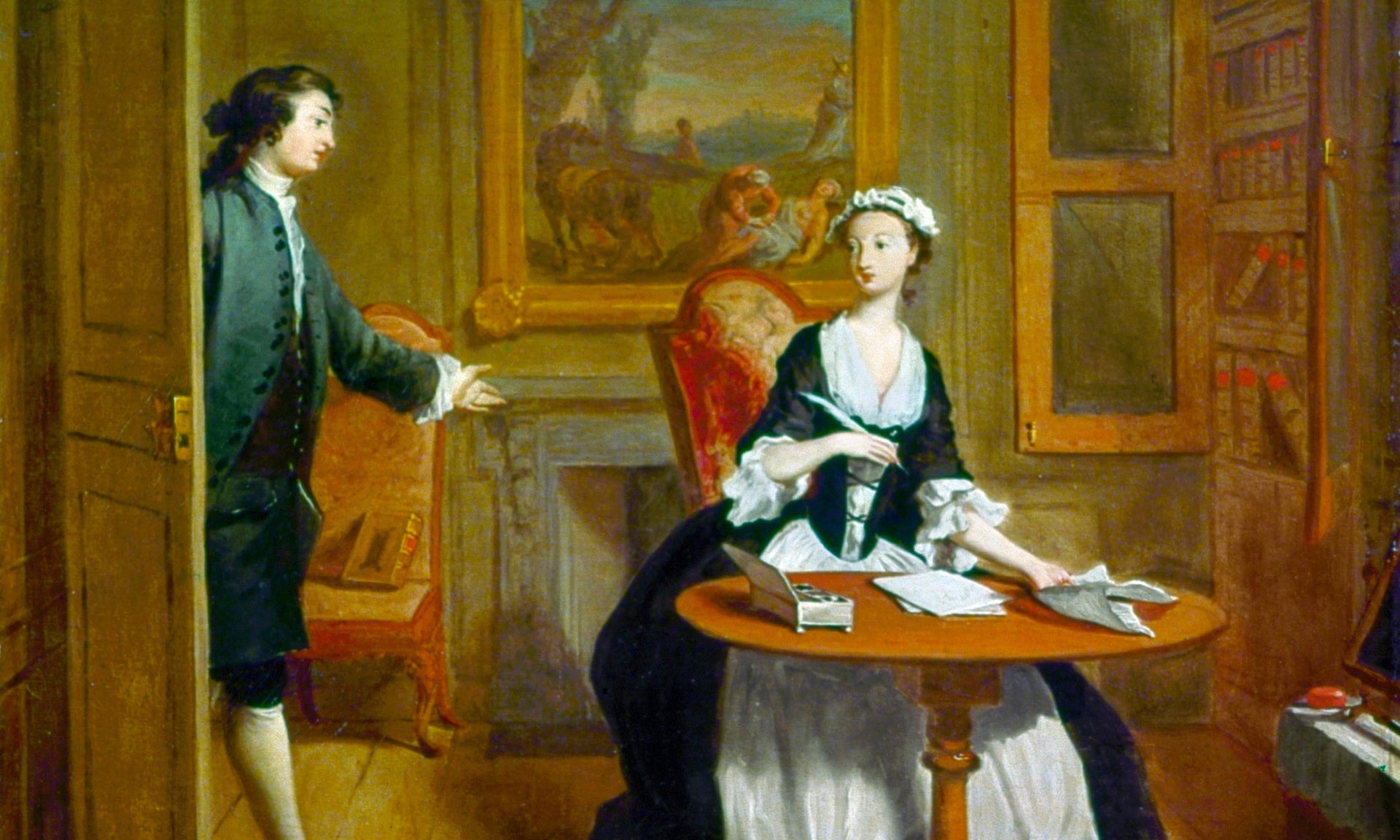
‘Mr B Finds Pamela Writing’ – oil on canvas, 1743-4, the first of a series of 12 paintings by Joseph Highmore illustrating scenes from Samuel Richardson’s novel Pamela.
Photograph: Granger Historical Picture Archive/Alamy
This piece at The Guardian by John Mullan gives an interesting perspective; relating the power dynamics at play and the predatory behaviour of one protagonist and the dilemmas of the other, with concerns and incidents we only know of too well in the here and now.
Written as a series of letters, and mostly by Pamela, Richardson seems to have come by a literary form adequate in conjuring the immediacy of a complicated and evolving relationship. Martin Crimp and Katie Mitchell and their players have come up with their own modern version (or vision!), to the satisfaction and dis- in equal measure it seems!
Love the Blanchett, would have loved to have seen this! London (I do believe the aforesaid has forsaken her antipodean home – again!) and the theatre – that’s a thing not many places can top!
I have always noted with interest the dedication and epigraph of a book – to whom if anyone – precise or otherwise (“To A.B.C. with love”!), sincere or ironic, inspirational or nonsensical. Sometimes they may mean nothing to anyone other than the author, but sometimes they are revealing (I think this is called paratextual).
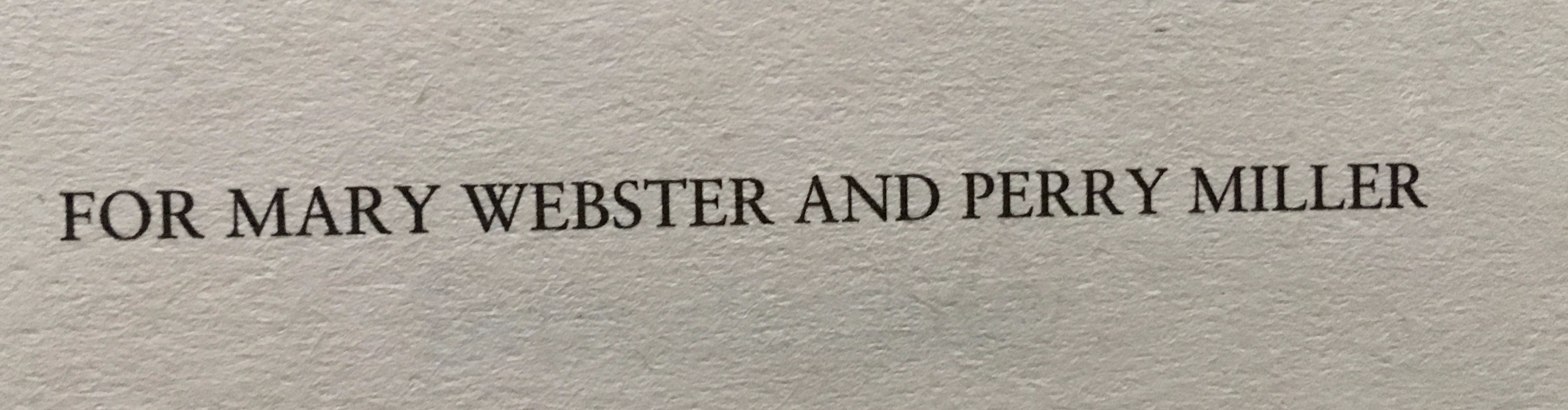
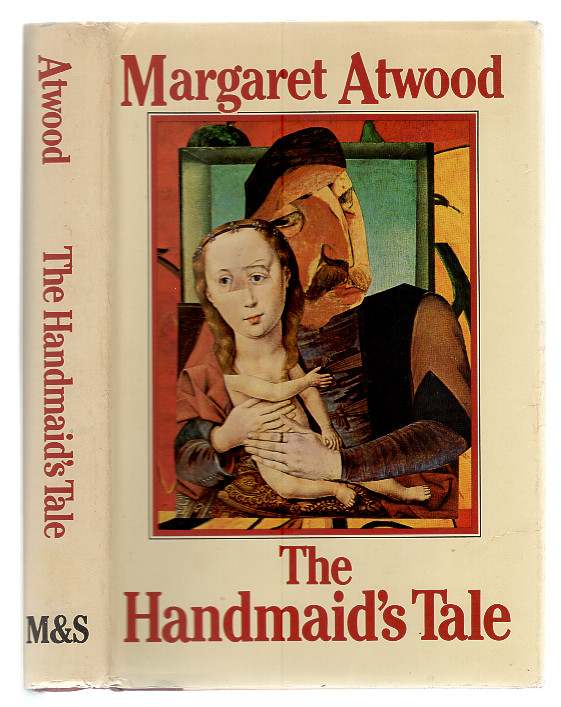
My attention recently diverted to thinking about Puritans (who I have never thought much about before!), I recalled Margaret Atwood’s dedication of The Handmaid’s Tale to the historian Perry Miller (and Mary Webster – an Atwood ancestor and victim of the Salem witch trials!) who so impressed her whilst at Harvard in the early sixties.
Confounded somewhat about how those first Puritans could reemerge so diabolically in her Republic of Gilead (and at the same time dwell in the good spirit of a Reverend Ames in Marilynne Robinson’s novel), and fairly ignorant to colonial New England history, and absolutely to the theological dimensions, I have resolved therefore to pursue a little of my own research (over time!). And a starting point may well be at least some reading of Perry Miller’s The New England Mind: The Seventeenth Century. Quite how far I will get I don’t know; it does seem somewhat daunting!
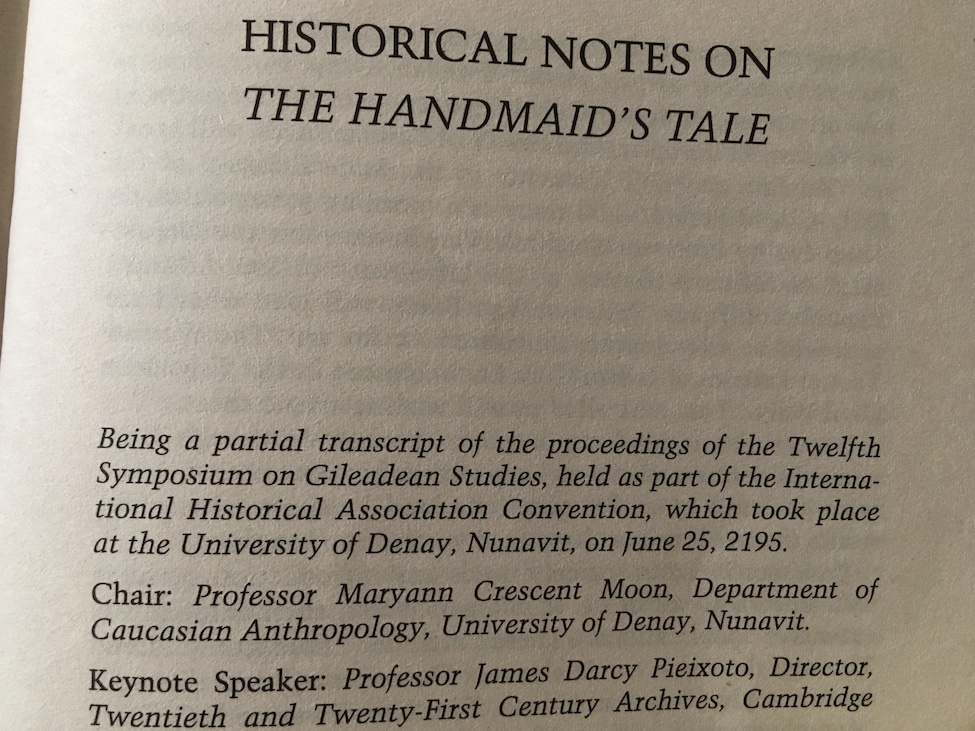
I have wondered though about that “Historical Note” that bookended rather than framed Atwood’s novel, and I think I can see that this literary device may have been influenced by what she took from Miller all those years ago; something perhaps like history to be seen in continuity, as inherited over and over, and inextricably embellished all the way along with the set of beliefs of the historian and his or her time. Atwood characterises her (rather obnoxious) historian as one analysing the past from the physical and intellectual coordinates of his present; oblivious that all these 200 years on he is carrying all the baggage from those two centuries. For Miller I think that meant that the Puritanism of colonial New England had only previously been understood in evidential terms, rather than conceding that the history being told was affected by the America of the ensuing years and the present.
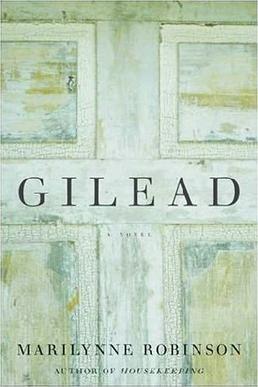
Not too long ago, I read Margaret Atwood’s The Handmaid’s Tale, and so it’s hardly any wonder that while reading Marilynne Robinson’s novel I was very much struck by these two very different fictional places being called Gilead – on the one hand Atwood’s dystopian rogue nation and on the other Robinson’s small town anywhere. Certainly, both are American, of a sort; one most definitely imagined, a pessimistic vision. And the other? A place of hope, romanticised like a prairie legend. And both are the scene for patriarchal narratives, albeit of a very different nature, and the biblical reference that lends both their name can be interpreted such as to justify the respective authorial intent. But the diabolical darkness of one is so contrary to the simple human failings and joys of the other, that one is tempted to take note and look not much deeper. But it was the coincidence (?) of place name that interested me, and the parallels that are exposed I find revealing and worthy of some thought.
Firstly, going back to the name. Gilead means “hill of testimony” – at least that is one accepted meaning – and both narratives are presented as testimonies – from a dying Rev. Ames and a handmaid (Offred) on the run (we think!) – and both tell their stories in that temporal fragmented way particular to memory. And as I said above, one just can’t get pass the generations of men and the societies they have defined; be it as men of God offering their interpretations of church and Godliness on a patch of Mid-western earth, or as degenerate Sons of Jacob perverting religion and taking the notion of patriarchy to its radical end in a Godless New England.
It also interests me that, like Atwood’s Handmaids and Commanders, Lila is so much younger than the good Reverend Ames, and this follows the Biblical narratives of old men and young women (especially the Israelite patriarchs Abraham, Isaac, Jacob), and both stories are driven by fertility, not just of man and woman but also of the land and its habitability and production affected by contamination and climate (and one could ask, where lies the fault: with the sins of man or by the will of God). This latter, this equating the people with the land works for both narratives and, as Ames’ would say, that is a wonder.
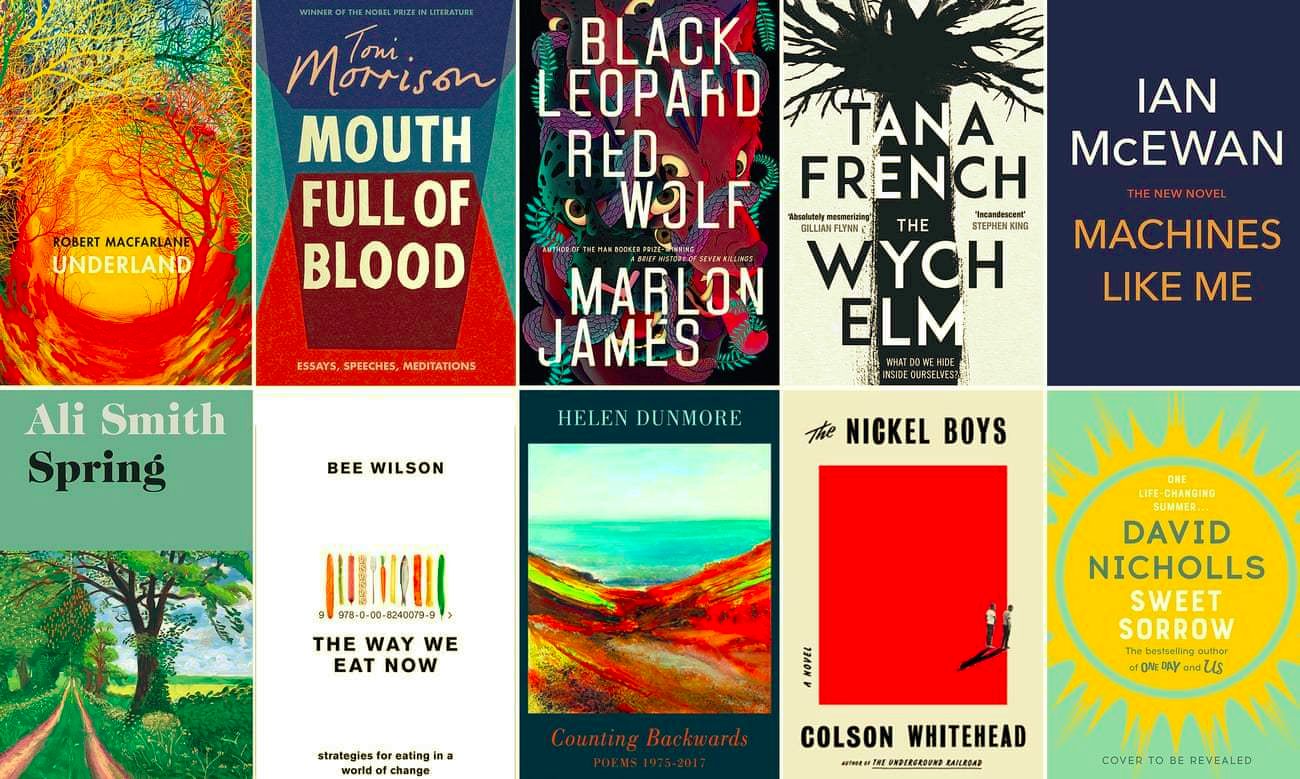
The Guardian has a good preview here of books to be published (in the UK anyway) in 2019.
Some that particularly interest me are:
Fiction:
Tessa Hadley’s Late in the Day – a favourite, who writes about lives that I know or want to know, or have lived.
Spring by Ali Smith – Problem! I have to read Autumn and Winter first! But I’m getting used to playing catch up.
Olive, Again by Elizabeth Strout – Yes, I have read Olive Ketteridge, sono catching up required here!
Colson Whitehead’s The Nickel Boys – hopefully a worthy follow up to The Underground Railroad
Siri Hustvedt’s new book – are there ever enough writing lives?
A first short story collection from Zadie Smith.
I love Ian McEwan – from the blurb, Machines Like Me is not necessarily what I would read, but love is love so …
Margaret Atwood – enough said.
Non-fiction:
Any bookish sort would find The Library Book from Susan Orlean pretty hard to resist.
I’m interested in the Bauhaus movement on many levels, so the Gropius biography by Fiona MacCarthy is a must.
Anything Toni Morrison has to say is okay by me – here a collection of essays.
What I do miss is Hilary Mantel’s final Cromwell instalment, The Mirror and the Light. The Guardian doesn’t seem to have comments running on this, so I did a look around, and at least in the summer Mantel seemed certain of a 2019 publication. Given the enormous interest, I am surprised that there is no news available.
I live in Germany, and Germany has what many other countries also have and tout, or aspire to have if only to tout, and that is, a special relationship with the US. And this often translates as a complicated relationship, and is reductive and too often simplified. I thought about this recently while reading reports in the German media, ostensibly about the end to Bruce Springsteen’s much acclaimed Broadway show, but where the overriding tenor was of “another” America, a better America, an “America the Beautiful”, as one particularly good piece was titled, and this America being personified by Springsteen. (Hallelujah to that I would say! But I am not here to talk about the Boss, or the original fan blah! or what that says about one’s age!) The comparison with the other America defined from another perspective is obvious enough and need not be pursued; my point here is the inherent diversity of place and people, and what if anything this has to say about a nation and national character.
This thinking about the everyman and everywoman, and how affected their narrative is by place, and how our perceptions are formed by place, coincided with my reading of Marilynne Robinson’s novel, Gilead. Written in 2004, I come to it belatedly I know, and I am in fact reading Robinson for the first time; her reputation of course is well known to me, at the latest with a legendary tête-à-tête with Barack Obama for the The New York Review of Books a couple of years ago.
Rev. John Ames’ epiphany, for Marilynne Robinson’s Gilead is just that – the revelatory testimony to a life well lived, is a monument of sorts to a gentler, kinder America. It could be fairly said that Gilead is a religious book, moralising in tone, but it is one that remarkably transcends a religious reading. The man, the father, the son, the husband, the brother, the friend John Ames explains himself, and while it is the Reverend Ames that bears witness with all the tools of his vocation, the thoughtful reader doesn’t need scriptural literacy nor to have read Calvin’s Institutes nor flirted with and rejected, or maybe not, Feuerbach; interesting as that all may be, needed only is an open mind (and heart) to explore beyond the particular (Christianity for instance) to what is being said of the greater human experience. The Reverend I indeed wanted very much to believe. I wanted to believe in the grace and goodness of his God. In the end though, it was the very human, less virtuous, John Ames that I journeyed with through the years and a landscape that could well be described as biblical, and with whom I felt the burden he carried of being the less favoured, less gifted son, but the one who stayed. I shared with him his self-imposed solitude and unrequited longings, and bemoaned an intellectual curiosity that had nowhere to go so went everywhere. I imagined intimately his losses and the wonder that came with the new so unexpected, so late in life. And I sat right there alongside him as he wrote it all down those last long nights through…
I must say, too, how very much I was captivated by John Ames’ voice – the cadence, the warmth – and found myself on occasions talking it out loud with some sort of (what I imagine to be!) mid-western accentuation, and even had moments of casting fantasies ranging from Henry Fonda to Sam Elliott – which sort of unites heaven and earth. A temptation a serious reader should resist I know!
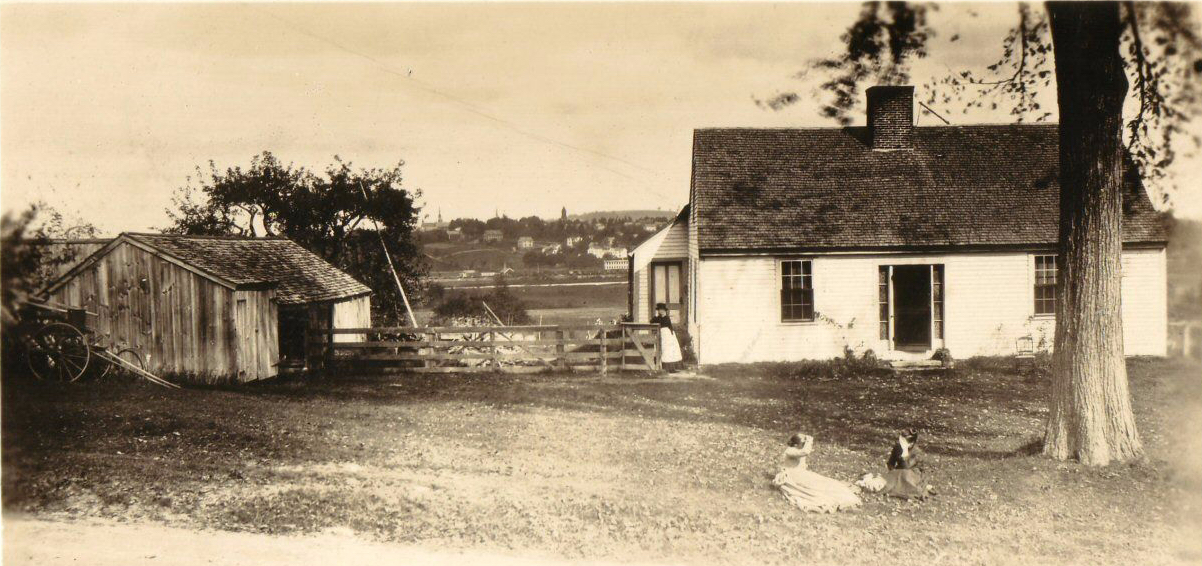
Gilead is so embedded in a very particular America, in the hardships, social norms and contradictions, and injustices, of a century gone, that it takes a leap of faith (is that a pun?) to insist upon its relevance. But I will. This old and dying man, from the more prosperous Fifties looking back and passing review on his own life and that of his forbears, allows a glimpse into a historic America, radically formed by its puritan roots, an ever evolving politic and the contrary demands of its vastness and a people displaced sometimes freely and often not, and always searching. But the themes that drive the narrative – of memory, of legacy, of the point of it all – are universal themes that transcend place and religion.
Just a wonderful read in my opinion – profound, uplifting and beautifully written – to be followed now by Home (2008) and Lila (2014), Robinson’s sequel novels to Gilead that seem to run parallel but with different voices. Home tells of the family of Reverend Boughton, Ames’ best friend, expanding upon the murky past of Jack Boughton (or more precisely John Ames Boughton), the fallen prodigal son; more than just alluded to in Gilead. And then Lila, told from the perspective of Ames’ wife, she who brought light and love to his later years, but with a story too of her own to tell. I look forward very much to completing the trilogy in the days ahead, and writing a little about them.
And I sat right there alongside him as he wrote it all down those last long nights through… I see before me the son reading the father’s testimonial in years hence…And the son will surely know so much more – he will know what happened next. He will know his mother and Jack as is his father did not. He will know of President’s who have lived and died. He will see wrongs being put right, but new wrongs being created… He is a young man leaving Gilead tomorrow, and with his father’s blessing…
My imagination runs away with me! But I can’t help but want to put together all the elegant shards of memory and fragmented personal narratives that Marilynne Robinson has left with me, but perhaps she will do the putting together – I did read somewhere that a quartet was always intended.
That I post this on the Christian feast day of Epiphany is only half coincidental!